

The Pokémon Trading Card Game has been around since 1996. Since then, over 43.2 billion cards have been sold worldwide.
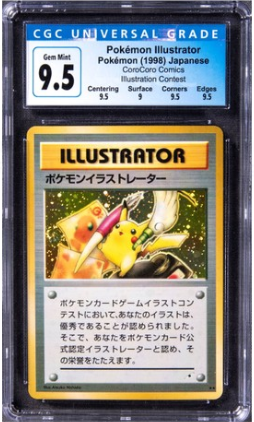
You may have heard of some rare ones like the 1st edition PSA 10 Shadowless Base Set Charizard that sold for $420,000 USD last March (2022). If you’re truly in the know then you might have heard of the card Pokémon Illustrator which holds the current record for most expensive Pokémon card sold at a private sale at a whopping $5.275 million.
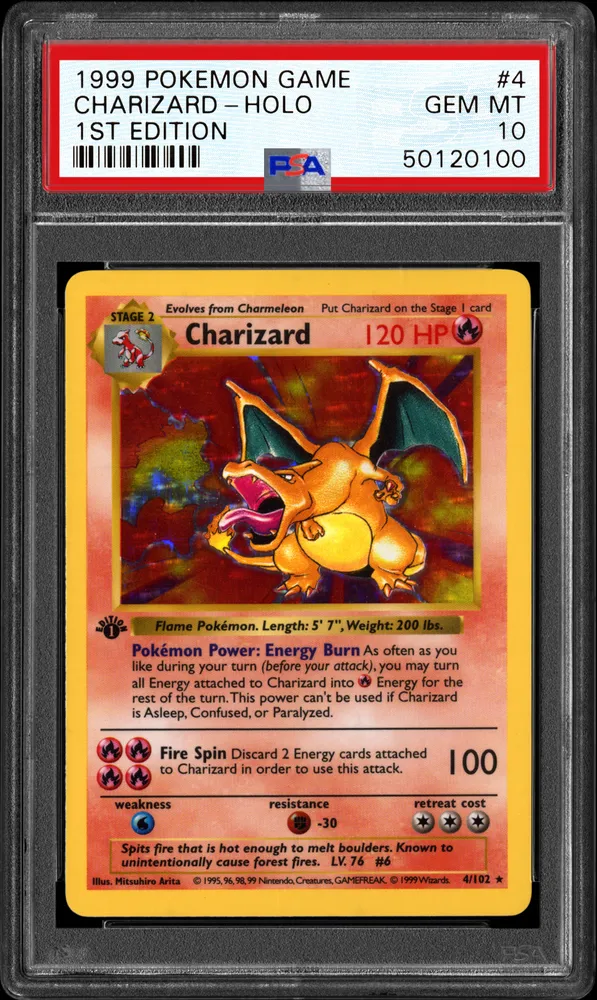
The large appeal of the Charizard (besides being a cool looking dragon) is its great condition (10 being perfect) which makes it even more rare since quality control for Pokémon cards was much worse back in 1999. It also has a first edition stamp signifying that it was printed on the first print run of the original base set. And finally, it is shadowless – a rarer version of the card without a drop shadow on the picture box. As such, only a handful of Charizard cards from Base Set will ever match all these specific features which makes it super rare.
The Illustrator card has a similar rareness to it, only 41 copies are known to exist (compared to the potential thousands of Charizard) and they were given out to winners of a promo contest held by Japanese magazine CoroCoro Comic. The scarcity and unique way to obtain these cards are what makes them so expensive.
Now, what if I told you that there is a card that is even rarer than both of these. Which has seen even fewer officially released copies and is arguably even more difficult to obtain than either of these. A card so rare that it isn’t even brought up into the conversation because people don’t know about it… Until now.
But before I get to it, I need to provide a small bit of backstory. Every year (since 2004), Pokémon hosts a competitive World Championships. Here, competitors battle it out for the chance to take home the title of “World Champion” and claim the trophy. But what you may not know is that every trophy comes with a trophy card.
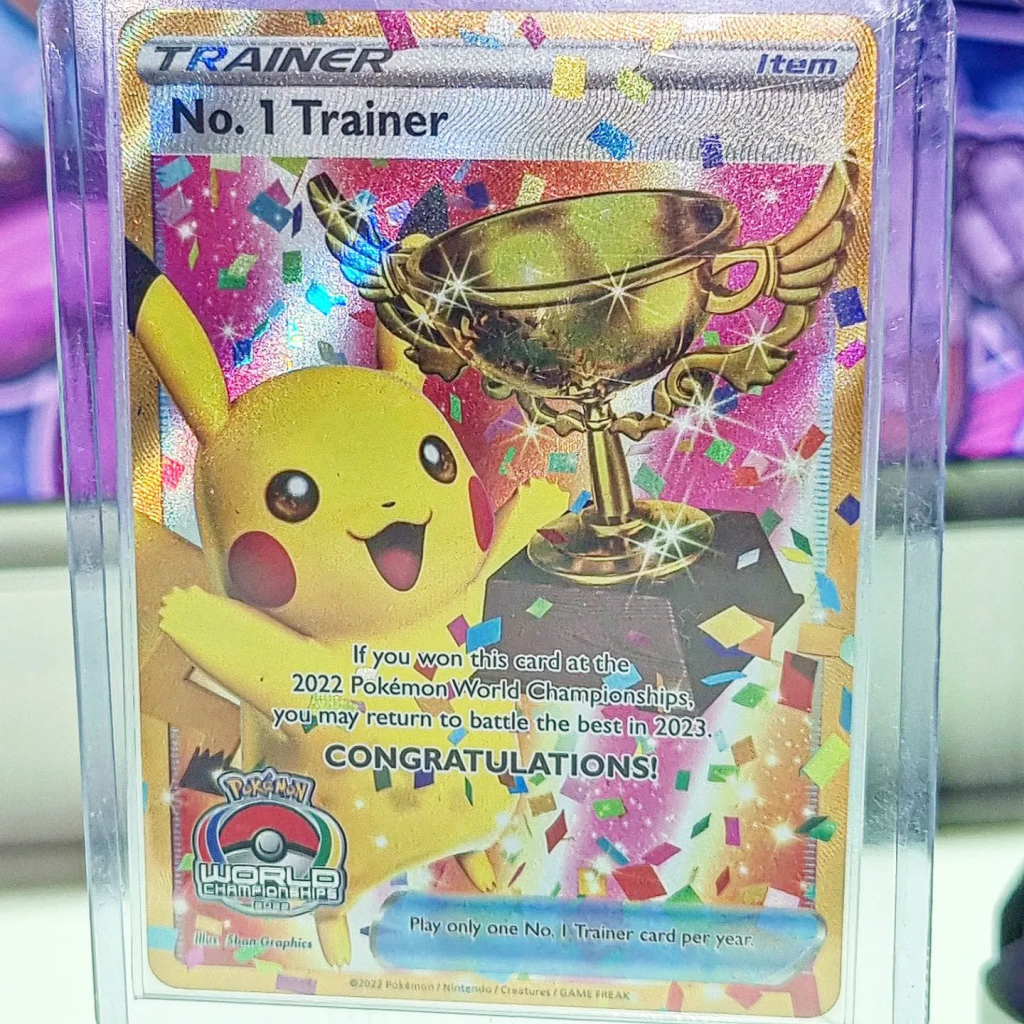
These cards are given out to the top 4 finishers in each age division in both the Trading Card Game (TCG) and the Video Game Championship (VGC) competitors.
Using this information, we can extrapolate the number of these cards that exist. Keeping in mind that there are three age divisions for the TCG and VGC tournaments.
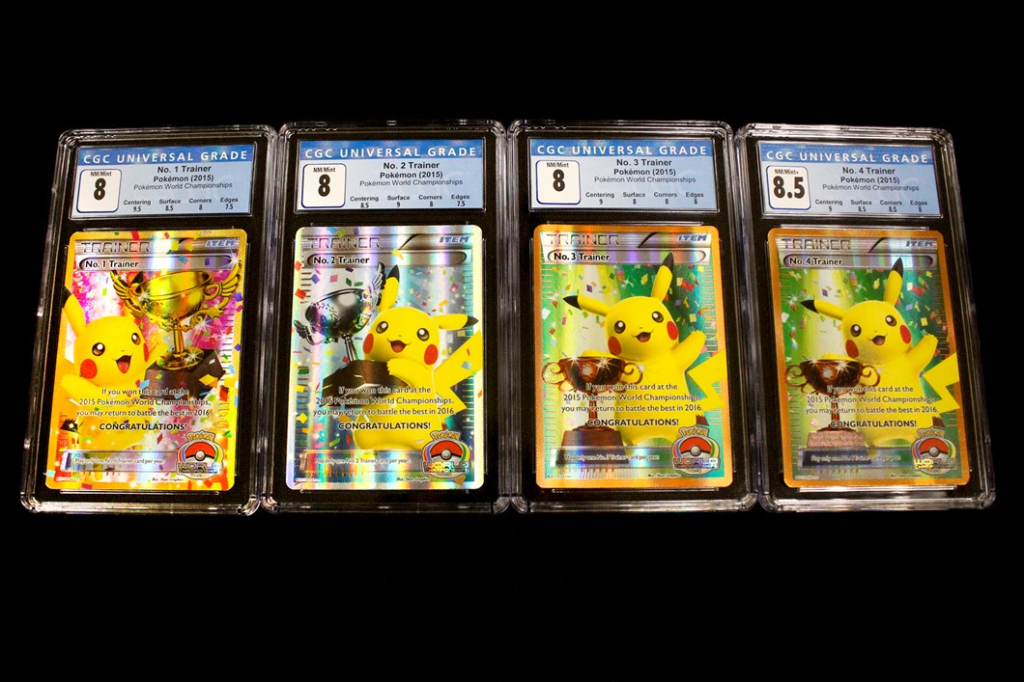
In 2022 alone, there would be three sets for TCG, three for VGC, six in total.
However, it wasn’t until 2013 that VGC would also receive these cards. And in 2020 and 2021 there were no World Championships so those can be discounted. Some simple math thus gives:
3x(2023-2004-2) [TO TCG WINNERS] + 3x(2023-2013-2) [TO VGC WINNERS] = 48 + 24 = 72 sets of trophy cards.
This is isn’t as scarce as Pokémon Illustrator but there is still more to consider.
The trophy cards used to be the traditional half-art Trainer cards and they have since switched to the fancier full-art cards in 2014.
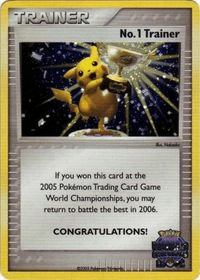
These half-art cards are thus more scarce and will continue to make up a smaller percentage of overall trophy cards as time goes on. Out of the 72 sets, 33 of them are half-art. In other words, there are just 33 of these “old-style” No.1 Trainer Cards out there. And we can still go even further.
The other big change that happened is that trophies (and thus trophy cards) had started to make their way down to 4th place. There used to be a 3rd place match (until 2009?) but then it switched to the person with the better record in the swiss rounds (higher seeding). This change took place in 2013.
Now, if you are an astute observer you might have caught it by now. And if you haven’t, don’t worry – most people did not know about this at all because it is hard to pick up on. The 4th place trophy was added in 2013, but the arts switched to full-arts in 2014. This makes it so that there is exactly ONE SINGLE YEAR where half-art No.4 Trainer Cards were awarded to 4th place finishers at the World Championships.
There are only 6 of these cards ever made. To obtain one, not only did you have to qualify for the World Championships and make it all the way to the top 4, you then had to LOSE and have a worse seeding than the other person who lost in top 4. Now, this prize wasn’t announced beforehand and the switch to full-arts wasn’t revealed until the following year so it really is just pure luck and happenstance that one comes to own these. This makes it a very unique card in the history of the competitive scene.
It is a rare piece of Pokémon history and I’m proud that I can hold on to it.
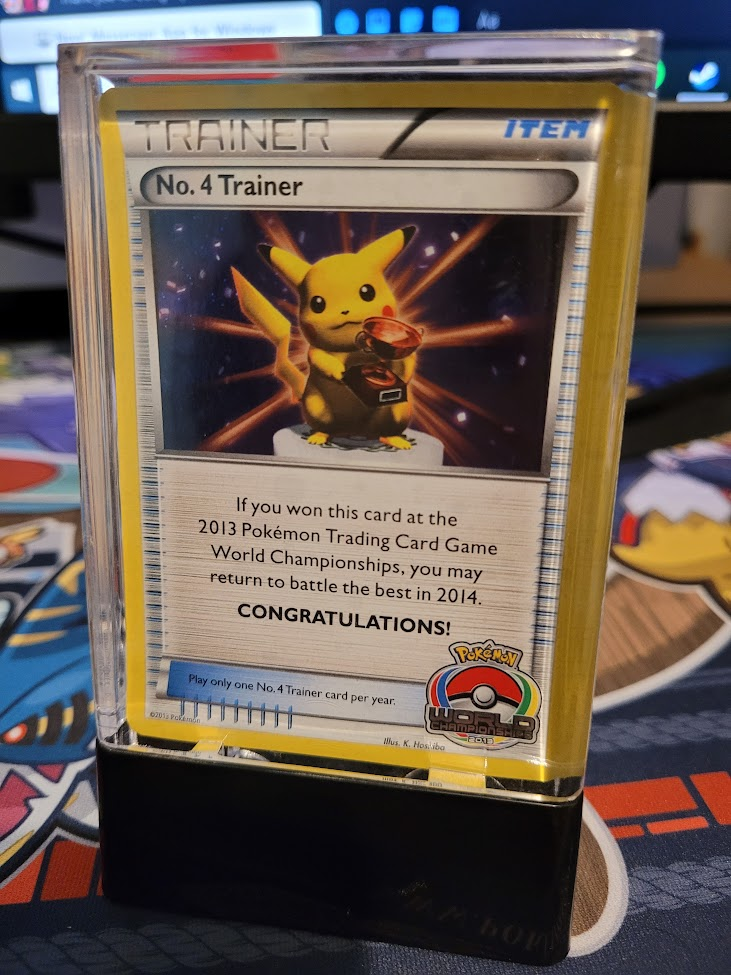

And that’s the story of the rarest Pokémon card that you never heard of.
2025 update
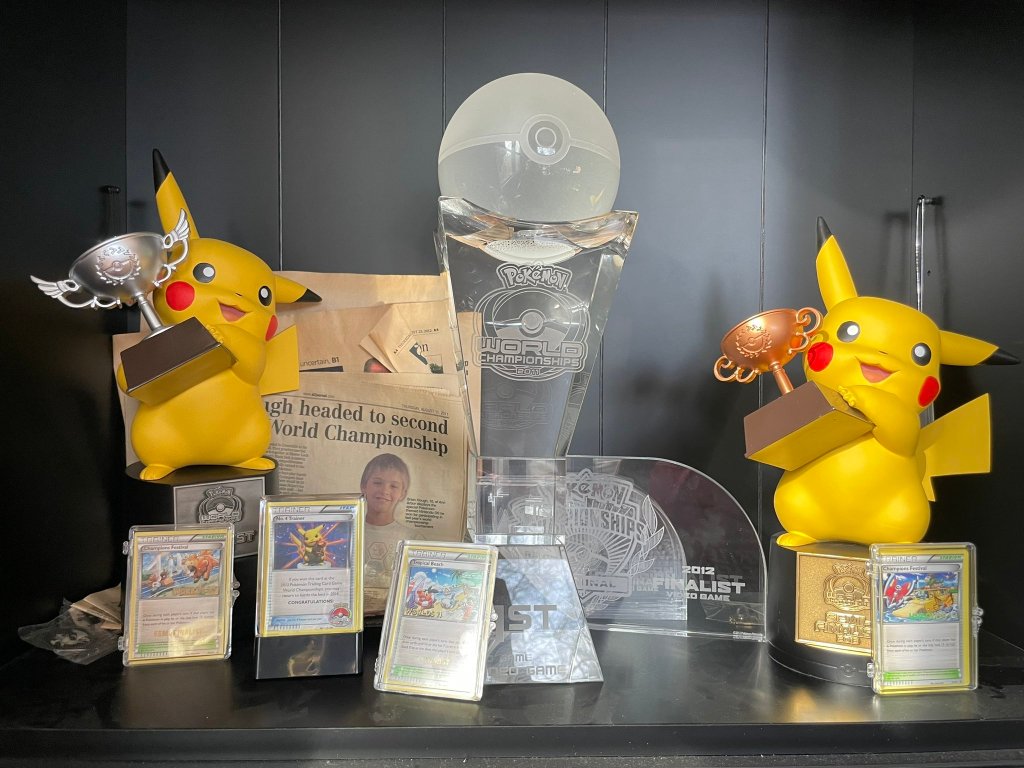
For years I kept this card in my trophy case on display as a mark of pride in my accomplishment from all that time ago. In August of 2024 I qualified for the World Championships in Hawaii, my 9th time competing since I started playing in 2007.
One cool service that they introduced at this event was on-site grading with Beckett. I decided now was my best chance to finally get my holy grail in a slab for safe-keeping.
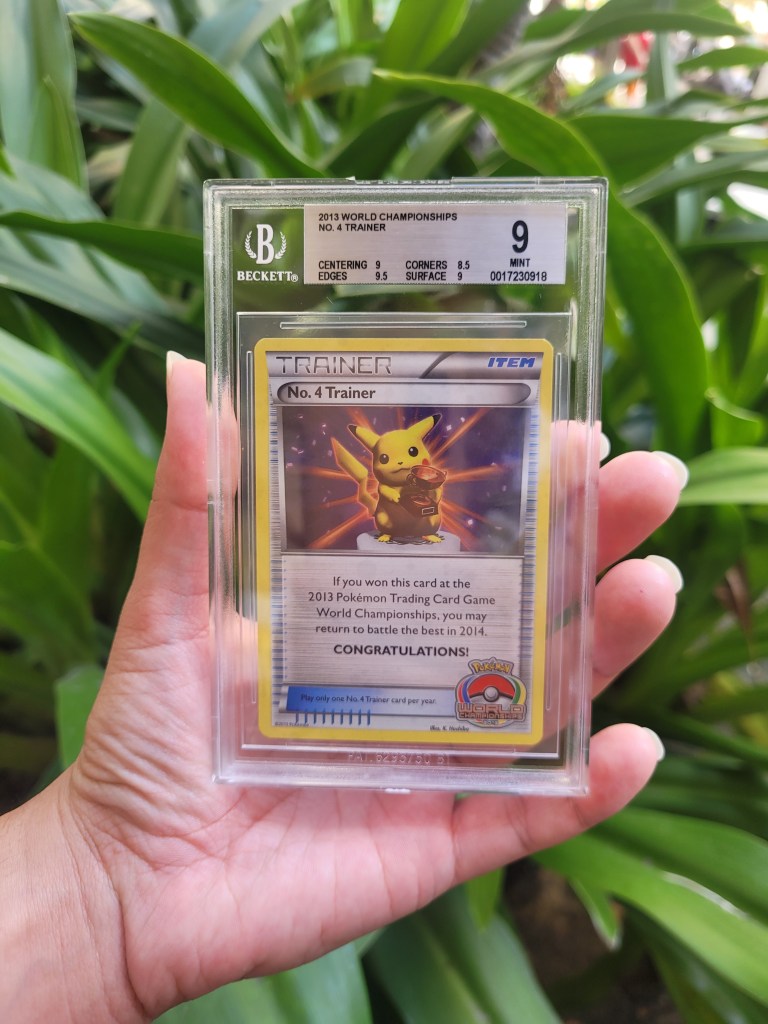
Shoutout to my lovely fiancé for being the hand model for this picture.
I ended up getting a 9, a grade I am more than happy with. For comparison, here are the other graded 2013 No. 4 Trainer cards that I have been able to find online:

On the PSA registry there appears to be a single copy that graded as an 8.
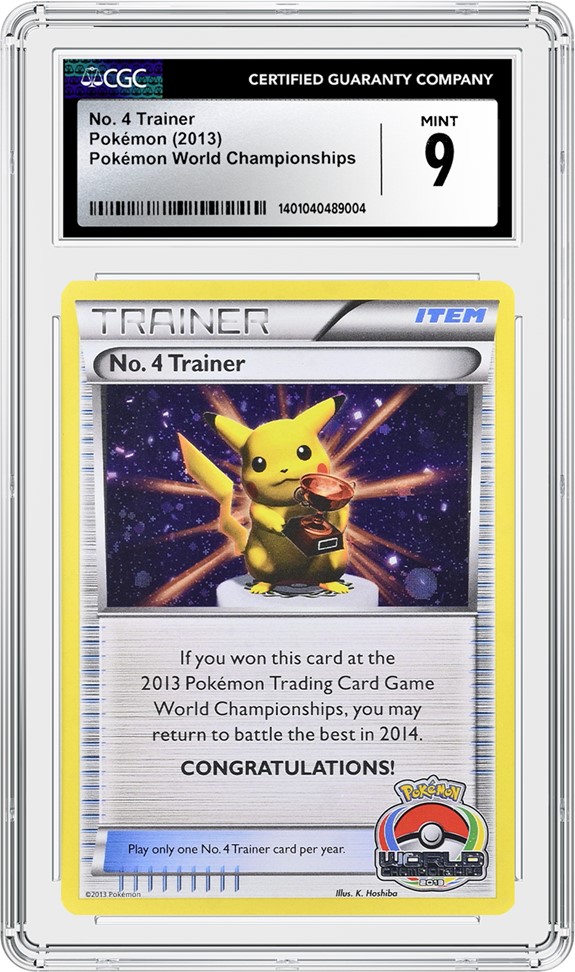
On CGC, a copy graded as a 9 and is featured on a CGC blog post here.
Famous collector, David Persin, recently posted parts of his collection for sale and in it we see one of every trophy card. We see that his copy is still ungraded.
Competitor who finished 4th in the Junior division of VGC in 2013 also has kept their ungraded copy according to a post in 2024.

This is four (or potentially five) out of the six known locations with two grading at a nine and one at an eight.
So what is this card actually worth?
The demand is niche but growing. This is a huge pickup for trophy card collectors, a potential holy grail. This could draw interest from card game historians as well as Pikachu card collectors.
In 2024, aforementioned collector David Perkins listed his collection of one of each World’s trophy card for sale on eBay. While the listed price to grab attention was $9M USD, the “real” price that he said he stated on his Instagram was $6M USD.
Now, if we just assume that all the trophy cards are around the same price (which definitely isn’t true) that would put each card at around $90k USD each.
That is what I would consider to be the floor. Not to mention, all of David’s collection was ungraded and his copy of No. 4 Trainer from 2013 was in a condition that he estimated would grade as an 8.5.
So, what is the ceiling?
Trading card collectibles have recently exploded in popularity and this has been especially true for Pokémon. Some cards have exploded in price in recent years and while some of this may be attributed to market manipulation and inflated hype, there are truly just so many more people in the hobby which increases the demand tenfold.
Truth is, there is no telling how high this could end up going for. With a distribution this selective and a population of just six copies, I wouldn’t be surprised if the thumbnail of this post becomes real one day.
 joey gaffney